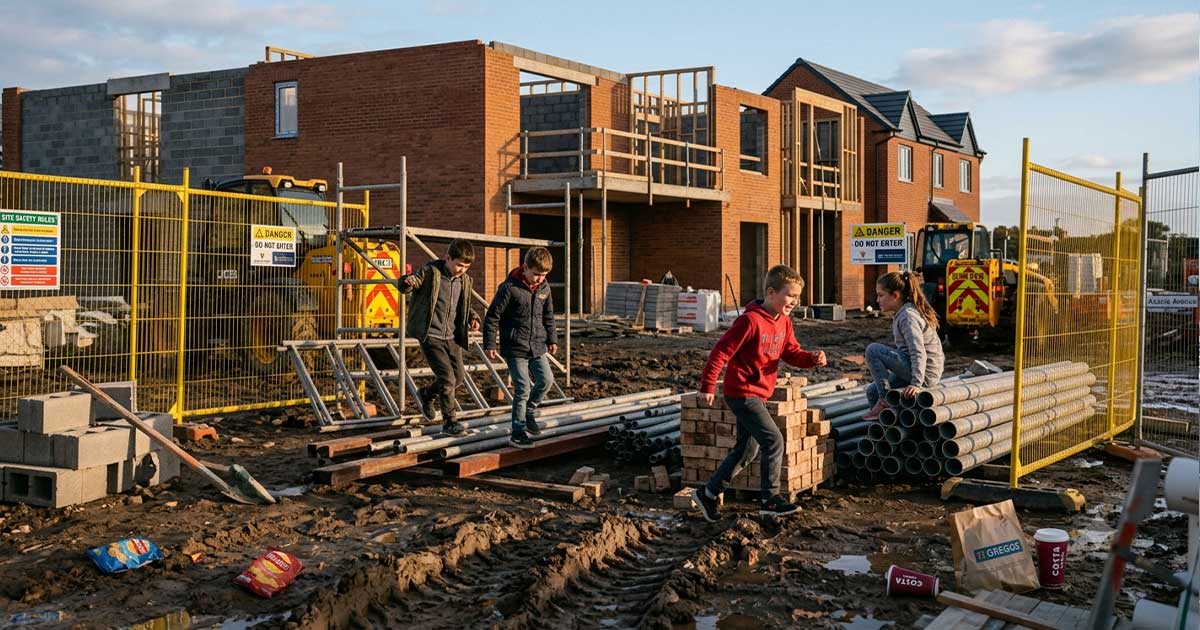
As the summer holidays approach, the Health & Safety Executive (HSE) has issued a fresh reminder to the construction industry: secure your sites and keep children out. In a press release published on 24 June 2026, the regulator urged everyone in control of a construction site to take extra precautions over the coming weeks, when schools close and children have far more free time to be outside and exploring.
It is a warning the industry hears every summer, and for good reason. Although incidents are thankfully rare, children have been seriously injured, and some have lost their lives, after getting onto building sites that were not properly secured. An empty site can look like an adventure playground to a curious child. The excavations, plant, stacked materials and part-built structures that are routine to your team are genuine dangers to someone who should never be there in the first place.
Site Security Is a Legal Duty, Not Just Good Practice
Securing your site is not optional. Under the Construction (Design and Management) Regulations 2015 (CDM 2015), those in control of a site have a clear legal duty to prevent unauthorised access. HSE points specifically to Regulations 4(6), 13(4) and 15(10), which place responsibility on clients, principal contractors and contractors to keep the public, including children, away from foreseeable harm.
Get it wrong and the consequences are serious on every level. A child can be hurt or worse, a local community is put at risk, and your business faces investigation, enforcement action and potentially prosecution. Site security is one of those areas where the cost of doing it properly is tiny next to the cost of getting it wrong.
The Practical Steps HSE Wants to See
The good news is that none of HSE’s recommended measures are complicated. The regulator has set out the controls it expects those in charge of sites to have in place:
- Put up suitable perimeter fencing or hoarding, chosen to suit the nature of the site and its surroundings.
- Check and review fencing and hoarding regularly, and repair anything damaged straight away.
- Secure the site properly at the end of every working day, not just at the end of the week.
- Barrier off or cover over any excavations and pits.
- Isolate and immobilise vehicles and plant, and lock them in a compound wherever possible.
- Store materials such as pipes, manhole rings and cement bags so they cannot topple or roll.
- Remove access ladders from excavations and scaffolds so they cannot be climbed.
- Lock away hazardous substances.
Several of these steps, including securing ladders and scaffolds, also connect to your duties around working at height.
These measures only work when they are applied consistently. The riskiest moments are often the quiet ones: the Friday afternoon when everyone is keen to get away, or the long light evening when a site sits unwatched. A short end-of-day security routine, owned by a named person, is one of the simplest and cheapest ways to close that gap.
A Particular Concern Across London and the South East
In built-up parts of London and the South East, far more sites sit directly among homes, schools and parks than in less densely populated areas. That proximity raises the stakes. A gap in the hoarding or an unlocked gate is not an abstract risk when there are children living and playing a few metres away. If your projects are close to residential streets, your site security needs to reflect that, and it needs to hold up not just during working hours but every evening, weekend and bank holiday too.
How Mast Safety Can Help You Get Ahead of It
If you are not completely confident your sites would stand up to scrutiny this summer, it is worth having a fresh pair of eyes look at them before a problem arises. Mast Safety works with contractors and principal contractors across London and the South East to review site security, tighten up CDM compliance and put practical, proportionate controls in place. Whether you need a one-off site security review or ongoing health & safety support, our consultants can help you protect the public and your business at the same time.