Once you know you are legally required to appoint a competent person, the next question is a practical one: should that person sit inside your business, or should you bring in an external service? Both are allowed. What many employers do not realise is that the law has a view on which comes first, and that view comes with an important condition attached.
What the Law Says About Who Fills the Role
The duty itself sits in Regulation 7 of the Management of Health and Safety at Work Regulations 1999, which requires every employer to appoint one or more competent persons to help meet their health and safety obligations. Less well known is Regulation 7(8), which states that where there is a competent person already in your employment, you should appoint them in preference to an external service.
In other words, the default the law leans towards is in-house. But that preference only applies where a genuinely competent employee already exists. That single qualifier is where most of the real decision lives.
Competence Is the Test, Not the Job Title
Competence under the Regulations is not a certificate on the wall. Regulation 7(5) frames it as sufficient training and experience, or knowledge and other qualities, to carry out the role properly. The honest question for any employer considering an internal appointment is whether the person nominated actually has the current knowledge and, just as importantly, the time to do the work.
It is common to find a willing employee handed the title on top of an already full job, with neither the hours nor the up to date legal knowledge the role demands. If you want a clear picture of the workload involved, our guide to what a competent person does day to day sets it out in detail.
The Case for Keeping It In-House
Where you have the right person, an internal appointment has real strengths:
- They are on site and immediately available when something needs a decision.
- They know your operations, your people and your hazards better than any visitor can.
- They can embed safety into daily routine rather than arriving to inspect it.
- For larger or higher-risk organisations, the sheer volume of work can justify a dedicated internal role.
Where you have someone with genuine competence, the capacity to do the work and the independence to challenge when needed, an internal appointment is both compliant and often the most responsive option.
The Case for Bringing in an External Service
For many businesses, an external competent person answers problems that an internal appointment cannot:
- Independence. An employee can find it difficult to challenge their own managers or raise an uncomfortable finding. An external competent person carries no such conflict.
- Breadth. Exposure across many sites, sectors and regulations brings perspective that a single organisation cannot build on its own.
- Keeping pace. Staying current with changing legislation and HSE expectations is a full-time discipline in itself.
- Continuity. An external service does not go on leave, resign, or leave a compliance gap when one person moves on.
- Cost. A retained external competent person can deliver the expertise of a safety manager without the cost of a full-time hire.
That last point is the basis of our external competent person service: expert support, sized to what your business actually needs.
Why the Hybrid Model Often Wins
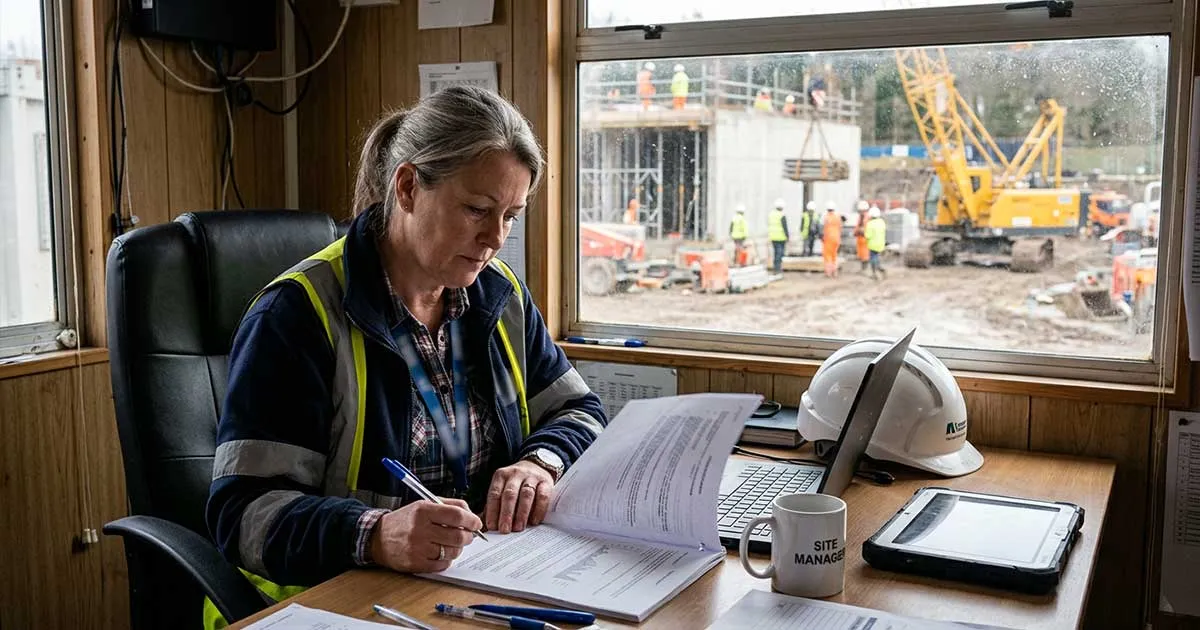
For a lot of businesses the answer is not one or the other. A capable internal contact handles day to day safety, supported by an external competent person who provides independent assurance, specialist input, audits and a second set of eyes on the areas that carry the most risk. This satisfies the Regulation 7 preference for an internal appointment while covering the gaps that a single in-house person, however good, will inevitably have. In higher-risk settings such as construction, that external support is often where the specialist knowledge sits.
How to Decide
A few honest questions usually settle it:
- Do you have an employee with genuine, current competence and the time to do the role, not just the willingness?
- How complex is your risk profile, and how much specialist knowledge does it demand?
- Do you need independent assurance, whether for your own confidence or for clients and accreditation bodies?
- Would a full-time safety hire be justified by your size, or would that budget stretch further as retained external support?
If you can answer the first question with a confident yes, the law points you in-house. If not, or if you need independence and breadth alongside it, an external or hybrid arrangement is usually the stronger route.
In-House or Outsourced Competent Person: Frequently Asked Questions
Can my competent person be one of my own employees?
Yes. The Regulations allow an employee to be appointed, and in fact prefer it where that person is genuinely competent and has the capacity to carry out the role.
Does the law actually prefer an in-house competent person?
It does. Regulation 7(8) says that where a competent employee exists, they should be appointed in preference to an external service. The key words are “where a competent employee exists”.
Is using an external competent person still compliant?
Fully. Where you do not have a suitably competent employee available, appointing an external service is the correct and compliant route.
Can we use both an internal person and an external service?
Yes, and many businesses do. A hybrid arrangement keeps day to day safety close to the business while adding independent assurance and specialist knowledge.
What if our nominated employee lacks the time or up to date knowledge?
Then they are unlikely to meet the competence test in practice. In that situation an external or supporting competent person is usually the safer and more compliant choice.
Find out how MAST Safety can help
MAST Safety acts as the external competent person for businesses across London and the South East, either as your sole appointment or alongside an internal contact. You get expert, independent health and safety support and the reassurance of continuity, without the cost of a full-time safety manager. Explore our consultancy packages or get in touch to talk through the right arrangement for your business.