On 1 July, the Health and Safety Executive published its provisional figures for work-related deaths in Great Britain across the 2025/26 year. The headline is one worth pausing on. A total of 126 workers lost their lives, which, setting aside the pandemic years, is the lowest annual total ever recorded. Twenty years ago the figure was 217. In 1981 it was 495. The long-term direction of travel is unmistakably downward, and every business that has taken workplace safety seriously has played a part in that.
A lower number, though, is not the same as an acceptable one. Behind each of those 126 is a family, a crew and a community, and the figures make clear that the risks driving workplace deaths have not fundamentally changed. For employers, the real value in this release is not the headline figure. It is the pattern underneath it.
The 2025/26 Figures at a Glance
- 126 workers killed in Great Britain, provisionally the lowest annual total on record outside the pandemic years.
- 25 deaths in construction, the highest of any sector by number, down from 35 the previous year.
- 31 deaths from falls from height, around a quarter of the total and again the single most common cause.
- 40 deaths among workers aged 60 and over, roughly a third of the total from just 12 per cent of the workforce.
Construction Still Carries the Heaviest Toll
Of all the main industry sectors, construction recorded the highest number of worker deaths at 25, followed by agriculture, forestry and fishing at 22. The construction figure is actually down on the previous year, when 35 workers died, so the sector has made genuine progress. Even so, it remains at the top of the table by volume year after year.
It is worth being precise about what that does and does not mean. Construction does not have the highest fatal injury rate per 100,000 workers. That distinction belongs to agriculture, forestry and fishing at 8.09, with waste and recycling next at 5.47, against an all-industry average of 0.37. Construction’s position at the top of the count reflects its size and the nature of the work rather than a sector that has stopped improving. The practical conclusion is the same either way. The hazards that kill people on site are well understood, and they are controllable.
Falls From Height Remain the Single Biggest Killer
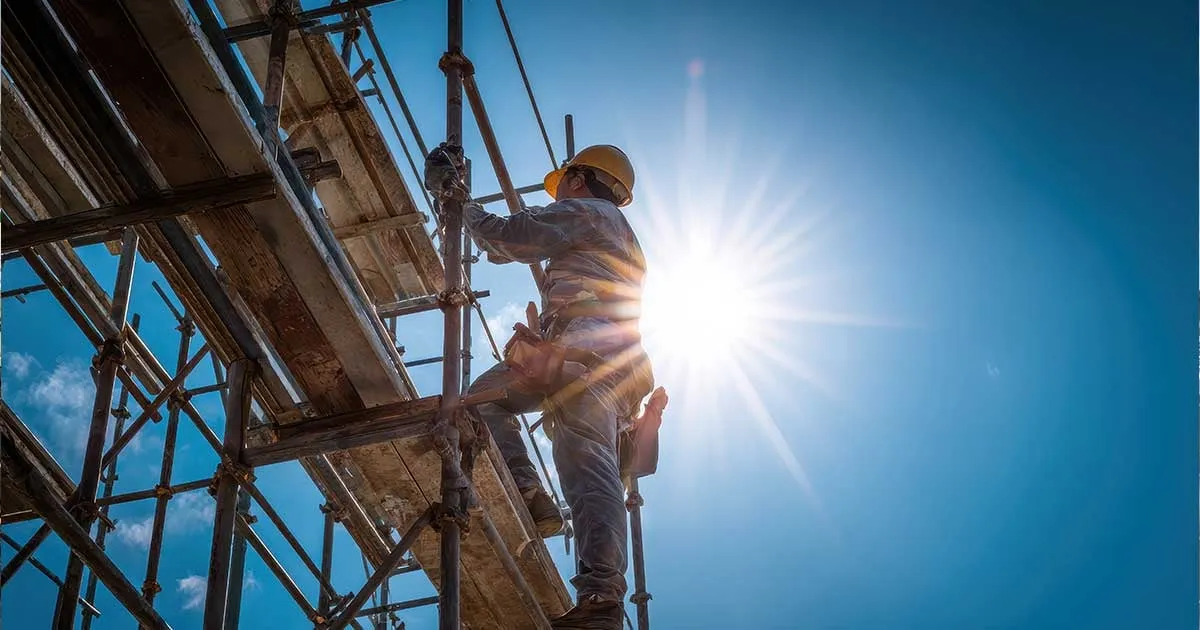
Across all industries, the most common cause of death was again a fall from height, accounting for 31 fatalities, or roughly a quarter of the total. This has been the leading cause for years, and it is the clearest example of a risk that is almost always foreseeable and preventable. Very few falls involve some freak, unforeseeable event. Far more often they trace back to work that was not properly planned, to equipment that was wrong for the task or missing altogether, or to a control that existed on paper but not on the day.
That is why falls from height sit at the heart of so much enforcement activity. When something goes wrong at height, the investigation almost always finds a gap between the risk assessment and what actually happened on site. Closing that gap is not about producing more paperwork. It is about competent planning, the right access equipment for the job, and someone with the authority and knowledge to stop work when a control is not in place.
An Ageing Workforce Is Carrying More of the Risk
One finding deserves particular attention. Workers aged 60 and over accounted for around a third of all deaths, some 40 fatalities, despite making up just 12 per cent of the workforce. Experience is an asset, but it does not remove physical risk, and it can sometimes disguise it. Employers with older, highly experienced crews should be careful not to assume that familiarity equals safety, particularly for tasks involving height, plant or heavy manual handling.
The figures also recorded 104 deaths among members of the public arising from work activity, up from 96 the year before. That is a reminder that an employer’s duty of care reaches beyond its own staff to anyone who could be affected by the work, a duty that sits right at the centre of the Health & Safety at Work Act.
What These Figures Mean for Your Business
Read as a whole, the 2025/26 statistics tell a consistent story. The workplaces that keep people safe are the ones that treat health and safety as an active, managed discipline rather than a file that gets opened when an inspector calls. The legal framework already points the way. The Management of Health & Safety at Work Regulations 1999 require every employer to carry out suitable risk assessments and to appoint one or more competent people to help meet their duties. The Work at Height Regulations 2005 set out a clear hierarchy for managing exactly the risk that continues to top the fatality table.
For most businesses, the gap is rarely a lack of good intentions. It is capacity and competence, which is to say having the time, the current knowledge and the independent eye to confirm that controls are genuinely working. That is where appointing a competent person or bringing in an experienced construction health & safety consultant earns its keep, whether through a one-off audit, support building a construction phase plan, or ongoing retained advice as part of a wider health & safety consultancy arrangement. If you are not confident your current arrangements would stand up to scrutiny, the time to check is now, not after an incident.
Work-Related Fatalities: Frequently Asked Questions
How many people died at work in Great Britain in 2025/26?
HSE’s provisional figures record 126 worker deaths in 2025/26. Excluding the years affected by the pandemic, that is the lowest annual total on record, down from 217 twenty years ago and 495 in 1981. The figures are provisional and will be finalised in July 2027.
Which industry has the most workplace fatalities?
Construction recorded the highest number of worker deaths at 25, ahead of agriculture, forestry and fishing at 22. Construction’s figure fell from 35 the previous year. Measured by rate per 100,000 workers, however, agriculture, forestry and fishing is highest at 8.09, well above construction and the all-industry average of 0.37.
What is the most common cause of death at work?
Falls from height, which accounted for 31 deaths, around a quarter of the total, and have been the leading cause for years. Most falls are foreseeable and preventable with proper planning, suitable access equipment and competent supervision, which is why they remain a central focus of HSE enforcement.
Do these statistics include deaths from work-related illness?
No. They cover fatal injuries from work-related accidents only. They do not include deaths from occupational diseases, such as cancers caused by past asbestos exposure, which HSE reports separately. Its latest figures record 2,146 mesothelioma deaths in Great Britain in 2024.
What should employers do in response to these figures?
Treat them as a prompt to confirm that risk controls are working in practice, not just documented. That means keeping risk assessments current, having a competent person to support health and safety decisions, and paying particular attention to high-consequence tasks such as work at height. A periodic independent audit is one of the most effective ways to find gaps before they cause harm.
Find Out How MAST Safety Can Help
Whether you need a straightforward audit, help getting your risk assessments and work-at-height controls right, or a competent person to support your team all year round, we work the way your business actually operates. Let’s talk about what would make the biggest difference.