Office environments are often treated as the safe end of the workplace spectrum. There are no scaffolds, no forklift trucks, no heavy machinery, and the most demanding physical task most people face is carrying a laptop between meeting rooms. It is easy to assume that health and safety law is something that applies to building sites and warehouses rather than to a floor of desks and screens.
That assumption is where many office-based businesses quietly fall short. The Health and Safety at Work etc. Act 1974 and the Management of Health and Safety at Work Regulations 1999 apply to every employer in the UK, regardless of sector. An office carries fewer obvious hazards than a construction site, but it is not a hazard-free environment, and the legal duties placed on the employer are exactly the same. The risks are simply quieter, and quieter risks are easier to overlook.
The Law Does Not Distinguish by Sector
The duty at the heart of UK health and safety law is to protect the health, safety and welfare of employees so far as is reasonably practicable. That wording does not change depending on what your business does. A software company, an accountancy practice and a marketing agency all carry the same baseline obligations as a manufacturer or a contractor.
In practical terms, an office-based employer is expected to assess the risks that genuinely exist in their workplace, put proportionate controls in place, and keep those arrangements under review. If you employ five or more people, you must also record the significant findings of your risk assessment and have a written health and safety policy. The standard is proportionate, so nobody is expecting an office to be managed like a construction site. But proportionate does not mean optional.
The Hazards That Actually Exist in an Office
The risks in an office are real, but they tend to build slowly rather than announce themselves. The most common areas an employer needs to manage include the following.
Display screen equipment
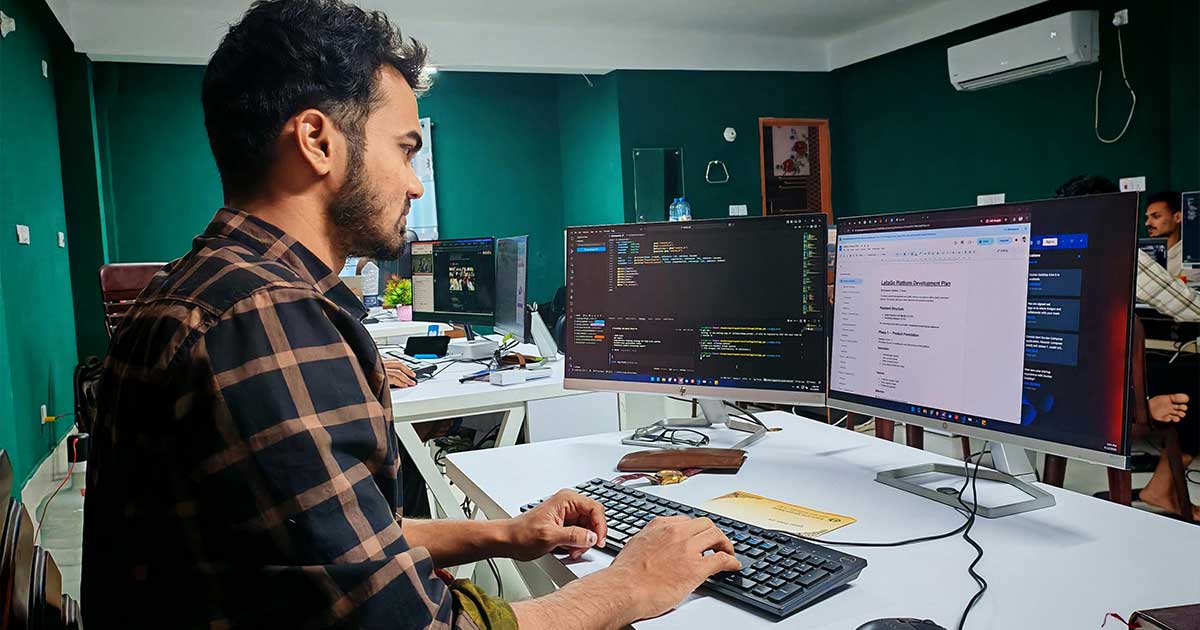
Anyone who uses a computer regularly as a significant part of their job is a display screen equipment user under the DSE Regulations. Employers must assess workstations, ensure screens, chairs, desks and lighting are set up correctly, and provide eye test funding on request. Poorly set up workstations are one of the leading causes of work-related musculoskeletal problems in office settings.
Musculoskeletal strain
Long periods seated, repetitive mouse and keyboard use, and badly arranged workstations all contribute to back, neck and upper limb complaints. These rarely produce a single reportable incident, which is part of why they are underestimated, but they are a significant cause of sickness absence.
Slips, trips and falls
This remains the most common cause of injury in office environments. Trailing cables, cluttered walkways, items left on stairs and wet floors after cleaning are routine causes. They are also among the easiest to control with simple housekeeping discipline.
Fire safety
Every workplace needs a fire risk assessment, clear escape routes, working detection and a tested evacuation plan. Offices are not exempt, and shared or multi-tenanted buildings bring added complexity around who is responsible for what. We cover this in more detail in our article on fire risk assessment and health and safety support for offices.
Welfare and the working environment
Temperature, ventilation, lighting, adequate space and properly maintained toilet and washing facilities are all covered by the Workplace (Health, Safety and Welfare) Regulations 1992. These are not minor administrative details. They are legal requirements.
Electrical safety
Offices are full of portable electrical equipment, from computers and chargers to kettles and heaters. Equipment must be maintained in a safe condition, and damaged items need to be identified and removed from use.
Mental health and wellbeing
Work-related stress, anxiety and depression now account for a substantial share of all work-related ill health in the UK. The duty to protect health includes psychological health, and HSE expects employers to assess and manage the risk of work-related stress in the same structured way they manage physical risks.
Best Practice: What Good Looks Like
Meeting the legal minimum and running a genuinely well-managed office are not quite the same thing. The employers who get this right tend to share a few habits.
They treat the risk assessment as a working document rather than a file that is completed once and forgotten. It is reviewed when the office layout changes, when new equipment arrives, when staff numbers grow, and at sensible intervals in between. They carry out DSE assessments properly when someone joins and revisit them if a person’s circumstances change, rather than treating it as a tick-box exercise on day one.
They keep fire safety arrangements live, with named fire marshals, regular drills and escape routes that are genuinely kept clear. They make sure someone in the business actually owns health and safety, with the time and the authority to manage it, rather than leaving it as an unspoken add-on to an office manager’s role. And they take mental health as seriously as physical safety, because the law makes no distinction between the two.
None of this is onerous for a typical office. It is mostly a matter of being deliberate rather than leaving things to chance.
Why Offices Get Caught Out
The pattern we see most often is not negligence. It is the assumption that an office is low risk enough not to need active management at all. A business books fire extinguisher servicing, assumes that covers fire safety, and never completes a fire risk assessment. Workstations are never assessed because nobody thinks of a desk as a hazard. The health and safety policy was written when the company was founded and has not been looked at since, even though the business has tripled in size.
These gaps usually surface at the worst possible moment. A client or prospective tenant asks to see the health and safety policy as part of due diligence. An insurer queries the arrangements after a claim. An employee raises a grievance about an uncomfortable or poorly managed workplace. At that point the absence of basic documentation becomes a real and visible problem, when it could have been addressed quietly and inexpensively well in advance.
How Mast Safety Can Help
Most office-based businesses do not need a full-time health and safety manager. What they need is access to qualified advice, a properly completed set of risk assessments, a current health and safety policy, and someone to keep those arrangements under review as the business changes.
Mast Safety provides exactly that through our Health & Safety Consultancy service. We work with office-based organisations to put practical, proportionate health and safety arrangements in place, acting as your external competent person, carrying out workstation and workplace assessments, reviewing your policy and documentation, and providing ongoing advice your management team can call on when they need it. The approach is tailored to how an office actually works, without the unnecessary complexity that puts businesses off managing health and safety properly in the first place.