Most businesses understand that they need a fire risk assessment. Fewer are clear on what a professional fire risk assessment service actually involves, how it differs from a self-completed checklist, and what they should receive at the end of the process.
This guide explains the practical reality of commissioning a professional assessment, what a competent assessor will do during and after the visit, and how to evaluate whether the service you are receiving is genuinely fit for purpose.
Why Professional Fire Risk Assessment Services Matter
Under the Regulatory Reform (Fire Safety) Order 2005, the fire risk assessment must be “suitable and sufficient.” That phrase has real legal weight. An assessment that misses significant hazards, fails to assess the risk properly, or produces recommendations that are vague or unworkable will not satisfy that standard, regardless of how it looks on paper.
Fire authorities have enforcement powers to inspect premises and review existing assessments. If they find an assessment that does not meet the required standard, the Responsible Person can face an enforcement notice requiring immediate improvements, a prohibition notice restricting the use of all or part of the premises, and in serious cases, prosecution.
The difference between a professional assessment and a template filled in by someone without specialist knowledge can be significant, particularly in premises with complex layouts, multiple occupancies, or higher risk activities. Getting it right matters.
What Happens Before the Assessment Visit
A professional assessor will want to understand your premises before arriving. This typically involves a brief initial conversation to establish the type of premises, its use and approximate size, the number of people present, any known fire safety concerns, and whether a previous assessment exists.
If you have an existing fire risk assessment, fire safety logbooks, maintenance records for fire alarm systems, emergency lighting test records, or any previous correspondence with a fire authority, having these available before the visit will allow the assessor to work more efficiently and produce a more complete picture of your current compliance position.
You do not need to have documentation in perfect order before commissioning an assessment. Identifying gaps in record-keeping is part of what the assessment is there to do. An assessor who tells you they can only work from complete records is setting an unreasonable bar.
What the Assessor Will Do On Site
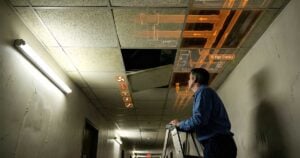
A thorough on-site inspection is the foundation of any credible fire risk assessment. The assessor will walk the entire premises, not just the areas that seem most obviously relevant. In a commercial building, that means plant rooms, roof spaces where accessible, basement storage areas, loading bays and any areas where contractors or cleaners operate, not just the main occupied floors.
During the inspection, the assessor will be looking at:
- Sources of ignition, including electrical installations and equipment, heating systems, hot work areas, and any other processes that generate heat or sparks
- Fuel sources, covering anything that could burn and contribute to fire spread, including storage of flammable materials, the construction of the building itself, and the contents of the premises
- Oxygen supply and anything that could accelerate fire spread, such as ventilation systems or open voids
- Existing fire detection and warning systems, including alarm panels, detectors, call points, and whether the system covers all relevant areas
- Emergency lighting, checking coverage, testing records, and whether escape routes are adequately lit in the event of a power failure
- Escape routes, including the width of corridors, the operation of fire doors, the direction of door swing on final exits, and whether routes are kept clear
- Firefighting equipment, including the type, siting, condition and maintenance records of extinguishers
- Fire doors, checking for correct certification, adequate seals and closers, and whether they are being propped open or otherwise compromised
- Signage, covering escape route signs, fire door signs, no-smoking signs and any other required notices
- People at risk, including whether any occupants have mobility impairments, work in isolated areas, or may be unfamiliar with the premises
- Management arrangements, including staff training records, evacuation procedures and the identity and awareness of the Responsible Person
The assessor will take notes and photographs throughout. This is standard practice and provides a clear record of the condition of the premises at the time of the assessment.
What the Written Report Should Include
The written report is the formal output of the assessment. For most businesses, this is what demonstrates compliance to insurers, auditors, and enforcement officers. A well-produced report will include:
- A description of the premises, its use and the scope of the assessment
- A record of significant findings, covering identified hazards and the risks they present
- An evaluation of existing fire safety measures and their adequacy
- An action plan setting out what improvements are required, with each action assigned a risk rating (typically high, medium or low) so you can prioritise work appropriately
- Recommendations that are specific and actionable, not generic
- A review date, confirming when the assessment should next be revisited
A report that simply states “no significant issues found” without any detail is rarely a credible output for a premises of any complexity. Similarly, a report that lists dozens of actions without prioritising them is of limited practical use. The report should give you a clear understanding of your current compliance position and a workable path to addressing any gaps.
The Difference Between a Professional Assessment and a Template
There are numerous free and low-cost fire risk assessment templates available online. For a small, low-risk premises such as a single-room office, a straightforward template completed by a knowledgeable person may be adequate. For most commercial premises, it will not be.
The limitations of a template-based approach become apparent in several ways. Templates do not adapt to the specific layout and use of your premises. They do not allow for the kind of professional judgement that identifies which hazards present a genuine risk in your specific context. They cannot assess whether your existing fire safety systems are adequate or appropriate. And they cannot provide the level of detail that an enforcement officer would expect to see for a larger or higher-risk premises.
A professional assessor brings practical experience of a wide range of premises types, an understanding of current legislation and guidance, and the ability to make judgements that a template cannot replicate. For premises where fire risk is genuinely present, that expertise has real value.
Ongoing Support and Review
A professional fire risk assessment service does not end with the delivery of a report. A competent provider will offer review reminders to ensure your assessment stays current, and will be available to advise on whether specific changes to your premises or activities require a reassessment before the scheduled review date.
For businesses with ongoing health and safety support arrangements, fire risk assessment can sit naturally alongside wider compliance support. If your organisation already has or is considering a Health & Safety Consultancy arrangement, fire safety is an area where integrated support provides the most consistent outcomes.
Fire Risk Assessment Services from Mast Safety
Mast Safety provides professional Fire Risk Assessments for commercial premises across Essex and London. Our assessors carry out thorough on-site inspections and produce clear, compliant written reports with prioritised action plans.
We work with businesses of all sizes, from single-site commercial tenants to multi-site portfolio managers. Our approach is practical and straightforward: we tell you what the assessment found, what needs to be done and in what order, and we are available to answer questions once the report has been delivered.
If you need a fire risk assessment for your premises in Essex or London, contact Mast Safety today to discuss your requirements.