A fire door is the one piece of fire protection that people interact with dozens of times a day, and the one most easily defeated. A wedge under the leaf on a warm afternoon, a closer disconnected because it slams, a hole drilled through the stile to run a cable. None of it looks like a safety failure. All of it stops the door doing the job it was rated to do.
Since January 2023 there has also been a defined interval attached to those checks for a large number of buildings, and a good many responsible persons still do not know it applies to them. This article sets out what the law asks for and how often, what an inspection actually looks at, and why the fire risk assessment sitting in your file does not answer the question.
A fire door is a system, not a door
It is tempting to think of a fire door as a heavier door. It is not. It is an assembly, tested and certified as a whole, and every part of it is load-bearing in the safety sense. The leaf and the frame are matched. Intumescent strips expand under heat to seal the gap between them. Cold smoke seals stop smoke passing before the fire is hot enough to trigger anything. The hinges, the latch and the self-closing device all have to be right, and the gaps around the leaf have to fall inside a few millimetres.
Change any one of those and the certification no longer describes what is hanging in the opening. That is why an FD30 door with a missing intumescent strip is not a slightly worse fire door. For the thirty minutes it was supposed to buy, it is a door.
What the regulations ask for, and how often
The Fire Safety (England) Regulations 2022 came into force on 23 January 2023 and put fixed intervals into law for the first time, aimed at multi-occupied residential buildings.
For buildings above 11 metres containing two or more sets of domestic premises, the responsible person must carry out quarterly checks of all fire doors in the common parts, and must use best endeavours to carry out annual checks of flat entrance doors. The best-endeavours wording matters: flat entrance doors are on the resident’s side of the threshold, so the duty is to make reasonable attempts and to record them, not to force entry.
For multi-occupied residential buildings of any height, the responsible person must also give residents information about fire doors at least annually, covering the basics: that fire doors should be kept shut, should not be altered, and that faults should be reported.
Below 11 metres, and in non-domestic premises generally, those Regulations set no interval. That is not the same as there being no duty. Article 17 of the Regulatory Reform (Fire Safety) Order 2005 requires that fire safety measures are maintained in efficient working order and in good repair, and fire doors are squarely a fire safety measure. A regime is expected; the law simply leaves the frequency to your risk assessment rather than naming it.
The faults that come up again and again
Across the inspections we carry out, the same handful of defects account for most failures:
- Gaps that have drifted. The gap around the leaf should be consistent and small, typically around three millimetres. Buildings move, doors drop on their hinges, and a gap that has opened to eight or ten millimetres will let smoke through long before the intumescent strip does anything.
- Strips and seals that are missing, damaged or painted over. Decorators are not fire door specialists. A coat of gloss across an intumescent strip can stop it expanding.
- Self-closers removed or defeated. Usually because the door slams, or because it makes a route inconvenient. A fire door that does not close is not a fire door.
- The wrong hinges, or too few. Fire doors need the correct number of correctly rated hinges, fitted properly. Loose or packed-out hinges are common in older stock.
- Holes and alterations. Cables run through the leaf, letterplates and vision panels retrofitted without rated components, a door planed down to fit a new floor covering.
Individually each looks minor. That is precisely the problem: nothing about a defeated fire door announces itself, and the moment it matters is the moment nobody is checking.
A fire risk assessment is not a fire door inspection
This is where the confusion usually sits. A fire risk assessment is essential and, for most premises, a legal requirement. It looks at the whole picture: ignition sources, escape routes, detection and warning, and how fire safety is managed. A competent assessor will note obviously defective doors as they go.
What it will not do is inspect every door in the building against its certification, measure the gaps, confirm the strips and seals are present and undamaged, count and check the hinges, or test each closer. The scope is breadth. A fire door inspection is depth, and it produces something a risk assessment cannot: a door-by-door record of condition, with defects identified and prioritised.
That distinction matters more than it used to. Where the 2022 Regulations set an interval, the expectation is that you can show the checks happened, on which doors, and what was done about what they found.
Finding the fault is half the job
An inspection that produces a list and no plan has not helped anyone. Defects fall into three broad groups, and they carry very different timescales.
Some are immediate and cost nothing: removing a wedge, reconnecting a closer, clearing an obstruction. Some need a competent joiner and the right certified components, which is most gap, hinge, strip and closer work. And some doors are past economic repair, usually where the leaf has been cut down, drilled through, or where nothing can be traced back to a tested specification.
Getting that triage right is what keeps the work proportionate. Our fire door remedial works service exists for exactly this reason: an inspection tells you where you stand, and remedial work is what changes it. Doing both together also means the records line up, so what was found and what was fixed sit in one place.
How MAST Safety can help
MAST Safety carries out fire door inspections for building owners, employers and managing agents across London and the South East. We inspect door by door, record condition against what each door is supposed to achieve, and give you a prioritised schedule rather than an undifferentiated list. Where work is needed, we can carry out the remedial works and re-record the doors once they are right.
Fire doors are also part of a larger picture. They are the moving parts of your compartmentation, and a perfect door in a breached wall protects very little. If you are looking at doors, it is usually worth looking at compartmentation and fire stopping at the same time, so the passive fire protection in your building is dealt with as one piece of work rather than three.
Fire Door Inspections: Frequently Asked Questions
How often should fire doors be inspected?
In multi-occupied residential buildings above 11 metres, the Fire Safety (England) Regulations 2022 require quarterly checks of fire doors in the common parts and annual best-endeavours checks of flat entrance doors. Elsewhere no interval is fixed in law, but the duty to maintain fire safety measures under the Fire Safety Order still applies, and your fire risk assessment should set a frequency appropriate to the building and its use.
Who is responsible for fire door checks?
The responsible person under the Fire Safety Order, usually the employer, building owner or managing agent. The duty can be delegated to a competent contractor, but the responsibility cannot: it remains with the responsible person, which is why records of who checked what, and when, matter.
What is checked during a fire door inspection?
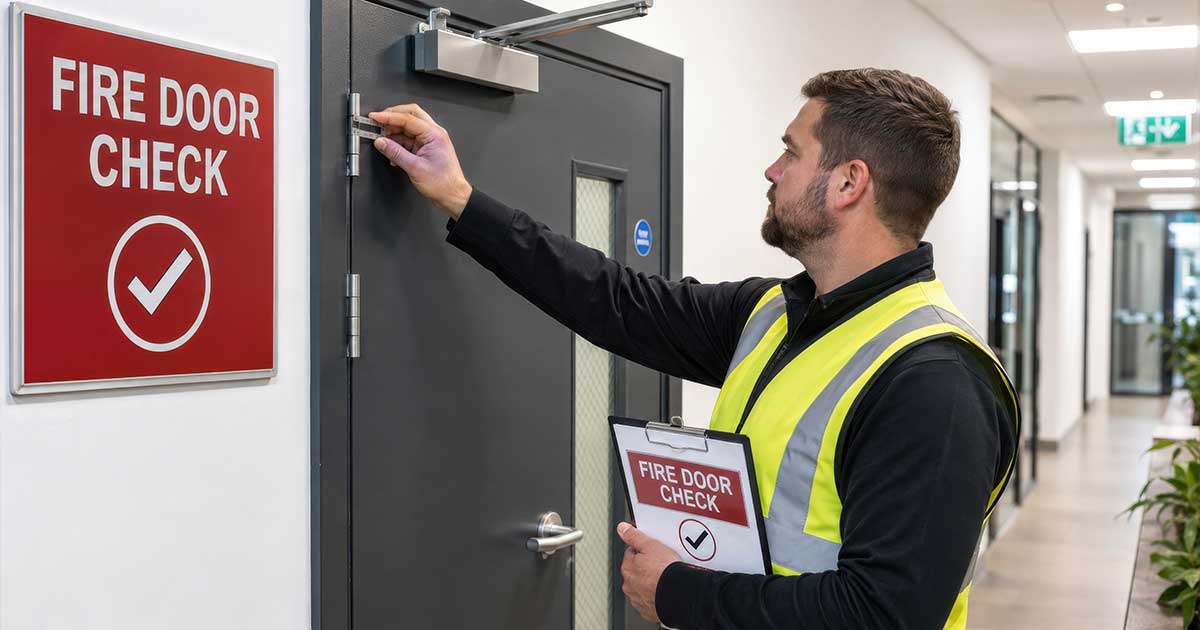
The certification and rating of each door, the gaps around the leaf and at the threshold, the condition of intumescent strips and smoke seals, the hinges, the latch, the self-closing device and its operation, any glazing, and any alterations or damage to the leaf and frame. The output should be a door-by-door record with defects prioritised.
Can a fire door be repaired, or does it need replacing?
Many defects are repairable using certified components, including strips and seals, hinges, closers and some gap adjustments. Replacement is usually needed where the leaf has been cut down or significantly drilled, or where the door cannot be traced to a tested specification. A good inspection tells you which category each door falls into rather than defaulting to replacement.
Know that your fire doors would hold
A fire door only has to fail once. Arrange an inspection and get a door-by-door record of where your building actually stands, with a plan for anything that needs putting right.